#include <play.h>
Public Member Functions | |
| Play (TbotsProto::AiConfig ai_config, bool requires_goalie) | |
| virtual std::unique_ptr< TbotsProto::PrimitiveSet > | get (const WorldPtr &world_ptr, const InterPlayCommunication &inter_play_communication, const SetInterPlayCommunicationCallback &set_inter_play_communication_fun) |
| const std::map< std::shared_ptr< const Tactic >, RobotId > & | getTacticRobotIdAssignment () const |
| virtual std::vector< std::string > | getState () |
Protected Member Functions | |
| virtual void | updateTactics (const PlayUpdate &play_update) |
Protected Attributes | |
| TbotsProto::AiConfig | ai_config |
| std::shared_ptr< GoalieTactic > | goalie_tactic |
| std::map< std::shared_ptr< const Tactic >, RobotId > | tactic_robot_id_assignment |
| std::map< RobotId, TrajectoryPath > | robot_trajectories |
| TbotsProto::ObstacleList | obstacle_list |
| TbotsProto::PathVisualization | path_visualization |
Detailed Description
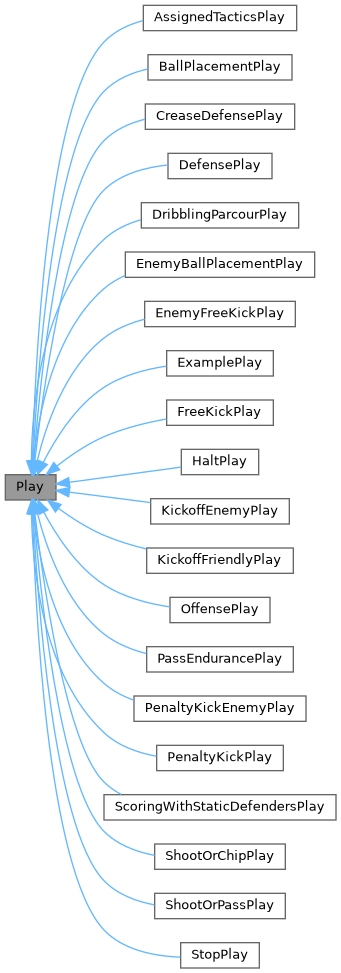
In the STP framework, a Play is a collection of tactics that represent some "team-wide" goal. It can be thought of like a traditional play in soccer. Some examples are:
- A defense play
- An offense play
- A corner-kick of free-kick play
Plays are stateful, and use Tactics to implement their behaviour. For the most part, this statefulness is used to created "stages" for each Play. For example, a corner-kick play be broken down into 2 stages:
- First, get the robots into position and find a good robot to pass to
- Execute the pass and attempt a one-touch shot on net
These stages are useful in order for us to create more complex behaviour and write it in a more understandable way.
Constructor & Destructor Documentation
◆ Play()
|
explicit |
Creates a new Play
- Parameters
-
ai_config The AI configuration requires_goalie Whether this plays requires a goalie
Member Function Documentation
◆ get()
|
virtual |
Gets Primitives from the Play given the the world, and inter-play communication
- Parameters
-
world The updated world inter_play_communication The inter-play communication struct set_inter_play_communication_fun The callback to set the inter-play communication struct
- Returns
- the PrimitiveSet to execute
Reimplemented in AssignedTacticsPlay.
◆ getState()
|
virtual |
Gets the state of the Play
- Returns
- a vector strings representing the state
Reimplemented in BallPlacementPlay, EnemyBallPlacementPlay, FreeKickPlay, PenaltyKickPlay, PenaltyKickEnemyPlay, and ShootOrPassPlay.
◆ getTacticRobotIdAssignment()
| const std::map< std::shared_ptr< const Tactic >, RobotId > & getTacticRobotIdAssignment | ( | ) | const |
Get tactic to robot id assignment
- Returns
- a map from tactic to robot id
◆ updateTactics()
|
protectedvirtual |
Updates the priority tactic vector with new tactics
- Parameters
-
play_update The PlayUpdate struct that contains all the information for updating the tactics
Reimplemented in AssignedTacticsPlay, BallPlacementPlay, CreaseDefensePlay, DefensePlay, EnemyBallPlacementPlay, EnemyFreeKickPlay, FreeKickPlay, HaltPlay, OffensePlay, PenaltyKickPlay, PenaltyKickEnemyPlay, and ShootOrPassPlay.
The documentation for this class was generated from the following files:
- src/software/ai/hl/stp/play/play.h
- src/software/ai/hl/stp/play/play.cpp