#include <cubic_bezier_spline2d.h>
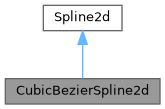
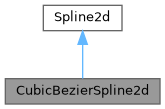
Public Member Functions | |
| CubicBezierSpline2d (const Point &start_point, const Vector &start_vector, const Point &end_point, const Vector &end_vector, const std::vector< Point > &intermediate_knots) | |
| const Point | getValueAt (double t) const override |
| const std::vector< Point > | getKnots () const override |
| size_t | getNumKnots () const override |
| std::vector< double > | getKnotParametrizationValues () const override |
| const Point | getStartPoint () const override |
| const Point | getEndPoint () const override |
| const std::vector< SplineSegment2d > | getSplineSegments () const override |
| const std::vector< Point > & | getControlPoints () const |
| size_t | getNumSegments () const |
Additional Inherited Members | |
 Static Protected Member Functions inherited from Spline2d Static Protected Member Functions inherited from Spline2d | |
| static SplineSegment2d | createSplineSegment2d (double start_val, double end_val, Polynomial2d polynomial) |
Detailed Description
A Cubic Bezier spline is a C2 continuous spline that is formed by a series of bezier curves.
Some useful resources: https://www.ibiblio.org/e-notes/Splines/Intro.htm https://www.ibiblio.org/e-notes/Splines/b-int.html
Constructor & Destructor Documentation
◆ CubicBezierSpline2d()
|
explicit |
Create a CubicBezierSpline2d that:
- starts from
startand is tangent tostart_vectorat the start ends at
endand is tangent toend_vectorat the end** EXAMPLE: **
                   XXXXXXXXX
start_vector  XXXXX         XXXXX   end_vector
      ^     XXX                 XXX     ^
      |    XX                     XX    |
      |   XX                       XX   |
      |  XX                         XX  |
      |  X                           X  |
      | XX                           XX |
      | X                             X |
      | X                             X |
      |XX                             XX|
      |X                               X|
      |X                               X|
      |X                               X|
start + + end
- Parameters
-
start_point The first point on the spline start_vector The tangent vector at the start of the spline end_point The last point on the spline end_vector The tangent vector at the end of the spline. NOTE: this points back along the body of the spline, instead of "off the end" of the spline. ie. this vector is "symmetric" with start_vectorintermediate_knots The intermediate points between start_pointandend_pointthat this spline will pass through
The direction of the start and end vectors determine the direction of the curve at the start and end points. The magnitude of these vectors determine how far the curve is stretched in the direction of the vector before connecting with the intermediate points
Member Function Documentation
◆ getControlPoints()
| const std::vector< Point > & getControlPoints | ( | ) | const |
Get the control points that are the implicit representation of the bezier curves that form this spline.
- Returns
- The control points that represent the the bezier curves that form this spline.
◆ getEndPoint()
|
overridevirtual |
◆ getKnotParametrizationValues()
|
overridevirtual |
Get the parametrization values corresponding to the knots of this spline
So for example, if we had a 3-knot spline that is linearly interpolated, this function would return {0, 0.5, 1}.
NOTE: There is no guarantee that the knots will be at linearly interpolated (equally spaced) intervals. This could return {0, 0.25, 1.0} and still be well defined.
- Returns
- The parametrization values corresponding to the knots of this spline
Implements Spline2d.
◆ getKnots()
|
overridevirtual |
Get the knots of this spline, including the start and end points
- Returns
- The knots of this spline, including the start and end points
Implements Spline2d.
◆ getNumKnots()
|
overridevirtual |
Gets the number of knots in the spline including start and end points
- Returns
- The number of knots in the spline including start and end points
Implements Spline2d.
◆ getNumSegments()
| size_t getNumSegments | ( | ) | const |
Get the number of segments on this spline.
- Returns
- The number of segments on this spline.
◆ getSplineSegments()
|
overridevirtual |
Get the segments that make up this spline.
- Returns
- The segments that make up this spline, with the order of segments being the order in which they appear along the spline, going from start to end.
Implements Spline2d.
◆ getStartPoint()
|
overridevirtual |
◆ getValueAt()
|
overridevirtual |
Calculates the value of spline evaluated at value t
- Parameters
-
t A value in [0,1] to get the value of the spline at. 0 is one endpoint of the spline 1 is the other endpoint of the spline
- Returns
- Value of spline evaluated at t. If t not in [0,1], then the closest endpoint
Implements Spline2d.
The documentation for this class was generated from the following files:
- src/software/geom/cubic_bezier_spline2d.h
- src/software/geom/cubic_bezier_spline2d.cpp